On the Ordering of Baby Keys
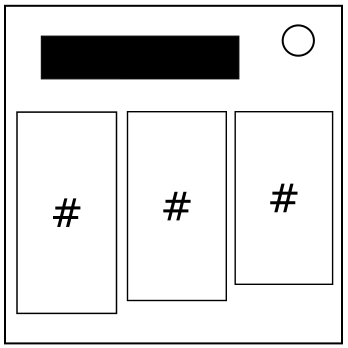
Comically small module, in a form of simplicity.
See Appendix ORDER for identifying modules in Ordered Keys family.
This small module consists of 3 colored keys, each of which is labeled with a colored number.
The possible colors for both the keys and the numbers labeling them are: (R)ed, (G)reen, (B)lue.
To disarm this module, complete 2 stages by pressing the keys in the correct order.
Each key has a value corresponding its position, the color of the label and the color of the key. Its corresponding sequence of values to press is determined by the labels of the keys.
- The table to use has a top-left digit equal to the position of the key, from left to right, 1 being the left-most key.
- The color of the label and the color of the key represents the row and column respectively.
| 1 | R | G | B |
|---|---|---|---|
| R | 1 | 2 | 3 |
| G | 2 | 3 | 1 |
| B | 3 | 1 | 2 |
| 2 | R | G | B |
|---|---|---|---|
| R | 2 | 3 | 1 |
| G | 3 | 1 | 2 |
| B | 1 | 2 | 3 |
| 3 | R | G | B |
|---|---|---|---|
| R | 3 | 1 | 2 |
| G | 1 | 2 | 3 |
| B | 2 | 3 | 1 |
- If all 3 digits are distinct, find that combination in parentheses and use the sequence assigned to the parentheses.
- Otherwise, use A as the digit displayed the most, and B (the Nth left-most digit of the serial number), modulo 2, where N is the stage number, counting from 1.
| A | |||
|---|---|---|---|
| B | 1 | 2 | 3 |
| 0 | 1,2,3 (3,2,1) | 2,3,1 (3,1,2) | 3,1,2 (2,1,3) |
| 1 | 2,1,3 (1,3,2) | 1,3,2 (2,3,1) | 3,2,1 (1,2,3) |