On the Subject of Draco Plate

Imagine having more defensive weaknesses than offensive strengths... So much for an “indestructible” type.

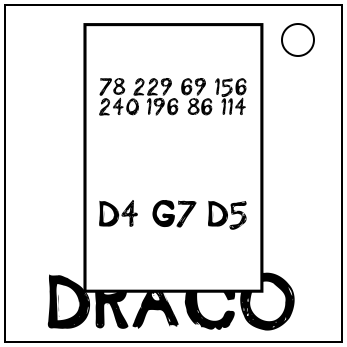
The Plate on the module contains ciphered information revealing a 8x8 grid of black and white pixels and CMY cells.

Your goal is to decipher the information, modify the grid using rules, and submit back a column or row by pressing on the Plate.

Deciphering the grid’s initial state:

Take the eight numbers at the top of the Plate.
Convert each number to a 8-digit binary number. Those are the 8 rows of the grid, in order. A 0 represents a black cell, and a 1 a white cell.

The inscriptions at the bottom of the Plate are three coordinates, representing the Cyan cell, Magenta cell and Yellow cell’s location respectively.

Top-Left corner is A1, letters increase going right, numbers increase going down.

Take the first letter and first number in the Serial Number.
Considering the top-left corner as A1 and the grid as looping, keep going right until you reach your letter, and down until you reach your number. This is the location of a Voided Cell.
0 is equivalent to an 8.
Repeat for the next letter-number pairs you can make with the Serial Number.

Submission process:

If the Serial Number’s third character is even, you will submit a column (starting at the top, going down); otherwise, a row (starting on the left, going right).
Take the number of ports on the bomb, and add/subtract 8 until it is in the range 1-8. You will submit the line whose index (starting at 1) is that number.

The topmost “Hollow” pressable area on the Plate submits a Black cell, the bottommost “Filled” submits a White cell.

Skip submitting Voided Cells, this means the submission can be less than 8 cells.

Pressing an incorrect area will give a Strike and ignore the last input. Do not restart the submission from the start.

You can press the “DRACO” text on the module’s casing to reset your submission.
Grid and Submission Rules:

Apply in order:

  1. The Cyan Cell Rules,
  2. Then the Cell Magenta Rules,
  3. And finally the Cell Yellow Rules

A coloured (CMY) cell is always considered white and can never be toggled.

For the entirety of the Cyan, Magenta and Yellow rules, the grid does NOT loop.

See Shared Appendix V O I D for more information about Voided Cells.

Cyan Cell Rules:

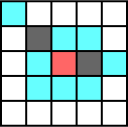
For every cell in the same row and column as the Cyan cell:

  • Toggle all of the cells at once.
  • Then apply the Game of Life rules to all of those cells, if applicable.

White cell turns black if not 2 or 3 white neighbors in surrounding 8, Black cell turns white if exactly 3 white neighbors in surrounding 8.

Magenta Cell Rules:

For all 3 Coloured (Cyan, Magenta, Yellow) cells:

  • Toggle their 4 orthogonal neighbor cells (do not forget about Voided Cells). The same cell can be toggled multiple times.
  • Find the 3 cells in the position of the Coloured cells if the whole grid was rotated 180°; and toggle those.

Yellow Cell Rules:

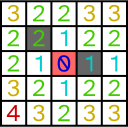
Toggle every cell whose Manhattan Distance to the Yellow cell is 2 or 4 or 8.

The Manhattan Distance is the distance obtained while only moving in cardinal directions. A diagonal neighbor is 2 Manhattan Distance away.
Shared Appendix V O I D shows how distances are affected by Void.

Interactive Table for your convenience:

Original code credit to LuminoscityTim (Critters) and samfundev (Game of Life).

Interaction Action
Click a cell Toggle between a black cell and an white cell
Or toggle the selected colour
Right-click a cell Mark a cell to be toggled

Shared Appendix V O I D:

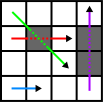
Voided cells are considered to not exist anymore. Cells aligned on either sides are considered adjacent and at a distance of 1. This includes diagonals.

You can move from one side of a Voided cell to another in a single movement. You cannot stop a movement onto a Voided cell.

Neighbors of a Voided Cell are the cells directly adjacent to it (unless one of them is a Voided cell, in which case the neighbors are of course one cell further).

Each arrow represents a single movement of length one Here are the 8 neighbors of a cell with Void around it Distances of a cell with Void in its surroundings