On the Subject of Dread Plate

Not reading all that... Do you have a TL;DR? a Summary? an In a nutshell?

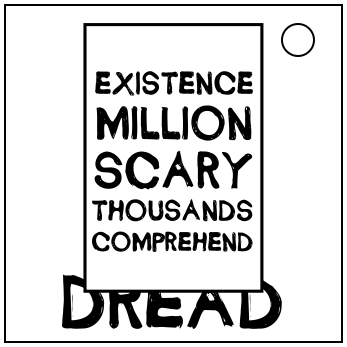
The Plate on the module is inscribed with several words which must be found in Appendix Dread and Voided.

Voided words are considered to not exist.

For example, in the sentence “This module’s Dread Plate”, if “Dread” is Voided, “This” is word 1, “module’s” is word 2, “Dread” doesn’t exist, and “Plate” is word 3.

Concatenate all of the Serial Number’s digits, call this your Offset.

Gather from Appendix Dread the words whose numbered position is the Offset; one starting from the beginning of the text, and one from the end.
Do not forget about Voided Words. Loop back if you go out of the text.
Hyphenated words such as “Medium-Sized” count as 2 words, while words with apostrophes such as “You’re” count as 1.

Append both words together, starting by the end one, and remove duplicate letters (keeping only the first occurrence).

Replace every letter with its symbol. This is your Character Sequence.

FHLNTVWX BDEGSU KMPRZ ACOQ IJY
# & % @ !

Then, apply the following rules in order, restarting at 1. every time a change is made in your Character Sequence, and prioritizing the leftmost character if multiple can be affected:

  1. If two of the same symbol are next to each other, remove one of them.
  2. If an & is next to an @, replace both with a single %.
  3. If a ! is next to an #, remove the !.
  4. If a @ is at the beginning or ending of the Character Sequence, remove it.
  5. If there are more than 2 Characters left, remove the leftmost # (if one’s present).
  6. Remove the leftmost symbol with the lowest count of associated letters in the table above.

When you have only one Character left, submit it onto the Plate.
Submitting the wrong Character will result in a strike.

Appendix Dread:

Do not forget that the numbers have to change depending on Voids!

“Human1. 518 existence is scary and confusing. A few hundred thousand years ago, we became conscious and found ourselves in19. 500 a strange place. It was filled with other beings. We could eat some; some could eat us. There was liquid stuff we could drink; things we could use to make more50. 469 things. The daytime sky had a tiny yellow ball that warmed our skin. The night sky was filled with69. 450 beautiful lights. This place was obviously made for us. Something was watching over us. We were home. This made everything much less scary and confusing.
“But the older we got, the100. 419 more we learned about the world and ourselves. We learned that the twinkling lights are not shining beautifully for119. 400 us, they just are. We learned that we’re not at the center of what we now call the universe, and that it is much, much older than we thought. We learned150. 369 that we’re made of many little dead things, which make up bigger things that are not dead, for some169. 350 reason, and that we’re just another temporary stage in a history going back over a billion years.
“We learned, in awe, that we live on a moist speck of dust moving200. 319 around a medium- sized star in a quiet region of one arm of an average galaxy, which is part219. 300 of a galaxy group that we will never leave. And this group is only one of a thousands that, together, make up a galaxy supercluster. But even out supercluster is only250. 269 one in thousands that make up what we call the observable universe. The universe might be a million times269. 250 bigger, but we will never know. We could throw words around like two hundred million galaxies or trillions of stars or bazillions of planets, but all of these numbers mean nothing.300. 219 Our brains can’t comprehend these concepts. The universe is too big. There is too much of it.
“But size319. 200 is not the most troubling concept we have to deal with. It’s time, or, more precisely, the time we have. If you’re lucky enough to live to one hundred, you have350. 169 five thousand two hundred weeks at your disposal. If you’re twenty- five now, then you have three thousand nine369. 150 hundred weeks left. If you’re going to die at seventy, then there are two thousand three hundred and forty weeks left— a lot of time, but also... not really.
“And then400. 119 what? Your biological processes will break down, and the dynamic pattern that is you will stop being dynamic. It419. 100 will dissolve until there is no you left. Some believe that there is a part of us we can’t see or measure, but we have no way to find out, so450. 69 this life might be it and we might end up dead forever.
“This is less scary than it sounds,469. 50 though. If you don’t remember the thirteen point seven five billion years that went by before you existed, then the trillions and trillions and trillions of years that come after will500. 19 pass in no time once you’re gone.
“Close your eyes. Count to one. That’s how long forever feels.”518. 1