On the Subject of Emoji Math
“They’re not emojis, they’re emoticons.”
Section A: Introduction
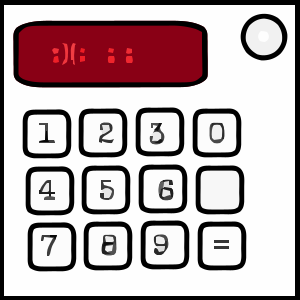
An Emoji Math module consists of a display with a keypad from 1-9 with a negative (-) sign as well as the submit button in a form of equals (=) sign.
Objective: To submit the right answer from the display by doing the math.
Section B: Step by Step
- The defuser will tell the text of the display in separate punctuation marks. There are colons “:”, brackets “()”, and bars (or line) “|”.
- There are plenty of ways to read the module’s read. People usually tend to say them one by one. The best way, with Faustian’s wise words, to read them one by one, there are only 4 punctuation types, colon, left bracket/open/opened brackets, right bracket/close/closed bracket, and bar/line.
- The expert should know that there are only two operators. Addition (+) and subtraction (-).
- Translate the module’s display with the table in Section C, two punctuation make one number.
- Do the math that the display gave, if it gave a negative number, press the negative sign (-), before entering the number.
- Press the equal sign (=) to submit your answer.