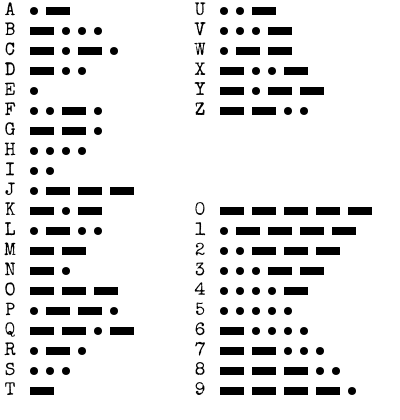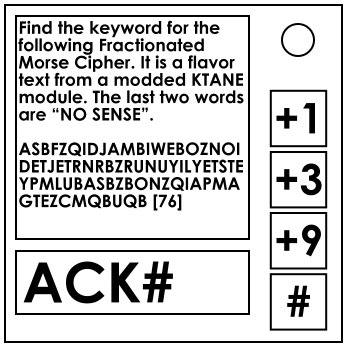
On the Subject of Fractionated Morse Cipher
Really? They’re now putting SCIENCE OLYMPIADS on bombs now??
*sigh*
Concepts can’t keep getting any worse from here, right?
...right??
This module contains a sentence from a random KTANE module’s alternative manual (not the original manual!), but the sentence has been encrypted using a Fractionated Morse Cipher.
To disarm this module, submit a valid keyword used to encrypt the message. Pressing the “1”, “3”, and “9” buttons will Caesar-shift the last letter forward in the alphabet that many times (but “#” is included as a “submit” character), with “+” being the “add” character. Entering “#” into the submission or entering 8 letters will submit the given word.
A “valid keyword” is a word such that when the original plaintext is encrypted using the word, the ciphertext matches the display.
Submitting a valid keyword will reveal the plaintext and solve the module. Incorrectly submitting a keyword, or otherwise submitting a word with duplicate letters, will cause a strike and clear the submission, but will not regenerate the module.
To assist with reading the encrypted message, the number of characters is given at the end of the message in square brackets. Additionally, to assist in the decryption process, the first or last word(s) of the message will be given as a hint.
What Is a Fractionated Morse Cipher?
A Fractionated Morse Cipher is a cipher that encrypts a message (in this example, “PLEASE STRIKE”) with these steps:
- The message (only letters and spaces) is converted into Morse Code
(PLEASE STRIKE → “
.--./.-.././.-/..././/.../-/.-./../-.-/.”). - The Morse Code is split into trigrams (groups of three). If the number of Morse Code characters is
not a multiple of three, slashes are appended until the length becomes a multiple of three
(“.--./.-.././.-/..././/.../-/.-./../-.-/.” → “.-- ./. -.. /./ .-/ ... /./ /.. ./- /.- ./. ./- .-/ .//”).