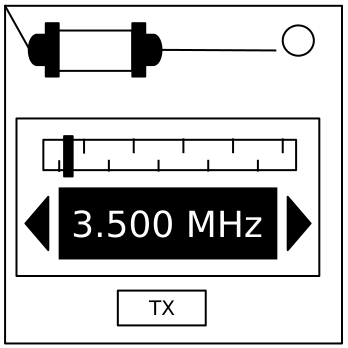
On the Subject of Morse Code
An antiquated form of naval communication? What next? At least it’s genuine Morse Code, so pay attention and you might just learn something.
- Interpret the signal from the flashing light using the Morse Code chart to spell one of the words in the table.
- The signal will loop, with a long gap between repetitions.
- Once the word is identified, set the corresponding frequency and press the transmit (TX) button.

| How to Interpret | |
|---|---|
|
1. A short flash represents a dot. 2. A long flash represents a dash. 3. There is a long gap between letters. 4. There is a very long gap before the word repeats. |
|
| If the word is: | Respond at frequency: |
|---|---|
| shell | 3.505 MHz |
| halls | 3.515 MHz |
| slick | 3.522 MHz |
| trick | 3.532 MHz |
| boxes | 3.535 MHz |
| leaks | 3.542 MHz |
| strobe | 3.545 MHz |
| bistro | 3.552 MHz |
| flick | 3.555 MHz |
| bombs | 3.565 MHz |
| break | 3.572 MHz |
| brick | 3.575 MHz |
| steak | 3.582 MHz |
| sting | 3.592 MHz |
| vector | 3.595 MHz |
| beats | 3.600 MHz |