On the Subject of Qubits

A bomb involving quantum mechanics? Just try turning it off and on at the same time.

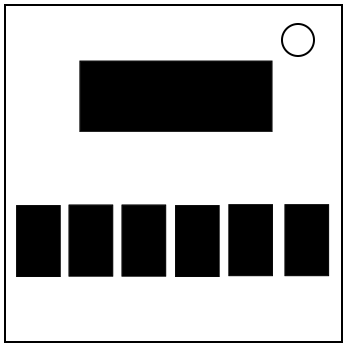
This module consists of a display at the top that contains 6 qubits. There are also 6 individual qubits at the bottom that are used for submission.

A qubit is a quantum bit, meaning it is both a 1 and a 0 at the same time until it is observed. This is called a superposition. Once observed, the bit will be either fully a 1 or fully a 0.

The diffuser can observe the 6 qubits on the top display by hovering over the display with their mouse. These can be interpreted together as a 6 digit binary number. The bottom qubits can be observed individually in the same way. Once the diffuser stops observing a qubit, it will return to its superposition.

The 6 qubits in the top display each have a 50% probability of being a 1 or a 0 except for one of them. The exception qubit is entangled with one of the other qubits. This means it will either always copy what the other qubit does, or it will always do the opposite. Exactly 2 of the qubits in the top display will be entangled with each other.

If the 2 entangled qubits always copy each other they are directly entangled and if they always do the opposite they are inversely entangled.

The 6 individual qubits at the bottom of the module are a bit different than the ones on the top display. Each qubit either favors 1 or 0. If a qubit favors 1, it has a 75% chance of being a 1 and a 25% chance of being 0 when observed. If a qubit favors 0, it has a 25% chance of being a 1 and a 75% chance of being 0 when observed.

Choose the correct set of instructions on the next page to determine a starting value.

If the entangled qubits are directly entangled

  • Take the decimal value of the entangled qubits if they were 1 and add them together. For example: if bits 1 and 2 were entangled the sum would be 32 + 16 = 48.
  • Add that to the character of the serial number in the position of the left most entangled bit (if letter convert with A = 1, B = 2...)
  • Divide the sum by the number of ports and round down to the nearest integer (If 0 divide by 1). This is your starting value.

If the entangled qubits are inversely entangled

  • Take the decimal value of the entangled qubits if they were 1 and average them. (round down to nearest integer)
  • Add that to the character of the serial number in the position of the right most entangled bit (if letter convert with A = 1, B = 2...)
  • Divide the sum by the number of batteries and round down to the nearest integer (If 0 divide by 1). This is your starting value.

Proceed through the table below for each of the individual qubits at the bottom of the module resulting in 6 different values.

If the condition is true, follow the instructions in the true column, otherwise follow the instructions in the false column.

Condition True False
This qubit favors 1 Start with the largest digit of the serial number Start with the position of this qubit (positions are 1 through 6 from left to right)
This qubit is in position 2, 3, or 5 Multiply by 7 Multiply by 4
The qubit in this position on the display is entangled Add (the number of qubits that favor 0 + number of battery holders) Subtract (the position of the left most entangled qubit on the display + the number of port plates)
The serial number character in this position is in the phrase: "Q6B1TS H8RT MY H34D" Add (the number of indicators + this qubit's position) Subtract (the number of ports + the position of the right most entangled qubit on the display)

After obtaining the 6 values, add them together and add them to the starting value. Take this total and modulo 64 (add or subtract 64 until it is in the range 0-63). This will be the final value.

To submit this value, convert it to a 6 digit binary number. You can press the bottom 6 qubits to permanelty observe them and lock in their value. Do this for all 6 so they display your 6 digit binary number. Once all qubits have been pressed your answer will be submitted. If you make a mistake and want to unpress one of the qubits, you can press the top display to reset all the qubits back to their superpositions.