On the Subject of Unwrapping Simon’s Scytale

Iuehehul i ​ esf ​ ​ n, ​ utmot. wwio wepheftyiituyin ​ s eopt goldwaslr

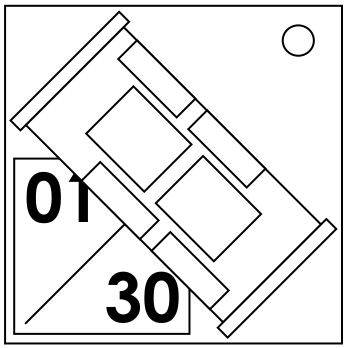
This module contains a large cylinder with six colors wrapped around it, along with two numbers at bottom-left displaying the position of the flash in the sequence. Hovering over a color reveals its first two letters of the color name in place of the bottom number. Solving the module requires encrypting the flashing sequence using three Scytale Transpositions.

Take the serial number and convert it to a 6-bit sequence: If the character is 0-4 or N-Z, the resulting bit is 0. If it’s 5-9 or A-M, the resulting bit is 1.

Modify the binary sequence using the following table:

If the bomb contains the module...
DSimon’s SumsCruel Boolean WiresModulo MazeSTerminology
..., invert the XXX bit.
1st2nd3rd4th5th6th

Put a six-color sequence under the binary sequence using the colors on the module (read from top-left to bottom-right). Follow the table below to get the three key colors using the number of 1s in binary sequence.

#1s Action
2/4 If the first bit is 1, treat the binary sequence as gray code, then convert it to binary (XOR each bit with the previous resulting bit; for example 111010→101100). Repeat this process until you get three 1s. The key colors are under the 1s.
If the first bit is 0, the key colors are under the four modal (most frequently occurring) bits, excluding the Nth modal bit, where N is the number of port plates modulo 4 plus 1.
3 If there are more lit indicators, the key colors are under the 1s. If there are more unlit indicators, the key colors are under the 0s.
If the number of lit indicators equal unlit indicators, the key colors are the first color, under the second 0 if there are no indicators, otherwise under the second 1, and finally the sixth color.
#1sAction
5The key colors are under the three 1s that come after the 0, wrapping around (for example 111101).
1The key colors are under the three 0s that come before the 1, wrapping around (for example 010000).
6If the number of batteries is odd, the key colors are the first 3 colors. Otherwise, the last 3 colors.
0If the number of ports is odd, the key colors are in odd positions. Otherwise, the even positions.

Take the key colors and their positions. Look them up in the table below to obtain the key numbers. A positive number represents encryption, while a negative number represents decryption.

Position/ColorRedGreenBlueCyanMagentaYellow
1st-6-4+3+2-7+5
2nd+2-3-7+5-6+4
3rd+5+7-4-6+2-3
4th-7+6+5-4-3+2
5th+3-5-2+7+4-6
6th-4+2+6-3+5-7

Apply the Scytale Transpositions to the flashing sequence. When viewing the module from the front, if the cylinder rotates up-rightwards, apply the three transpositions from right to left. If it rotates down-leftwards, apply the three transpositions from left to right.

Input the final sequence by pressing the colors. You can type in a letter RGBCMY to press that color on the module. You must wait until the pressed color becomes unlit before pressing another color. The bottom-left corner will show the number of correct presses. The module will solve when you have inputted the entire sequence correctly.

If at any point an incorrect color is pressed, the module will strike. The new flashing sequence that you now must encrypt, is the old answer. The colors on the module and the cylinder rotation will not change.

Encrypting With A Scytale Transposition (+)

Make a grid with number of rows equal to the key number and columns equal to (sequence length divided by key number, rounded up). Fill in the grid with the sequence in reading order (left to right, top to bottom).
If the sequence length is not a multiple of the key number, make sure to leave the bottom x cells of the last column empty, where x equals key number minus (sequence length modulo key number).

Example with “THESCYTALESITUATION” (length 19) and key 3:

THESCYT
ALESIT
UATION

Finally, read the grid letters column-by-column (top to bottom, left to right) to obtain your encrypted sequence. In this example, “THESCYTALESITUATION” is encrypted to get “TAUHLAEETSSICIOYTNT”.

Decrypting With A Scytale Transposition (-)

Make a grid with number of rows equal to the key number and columns equal to (sequence length divided by key number, rounded up). Fill in the grid with the sequence column-by-column (top to bottom, left to right). Example with “TNGEHOTHETOERHSREIEESN” (length 22) and key 4:

THERES
NOTHIN
GTOSE
EHERE

Finally, read the grid letters in reading order (left to right, top to bottom). In this example, the result is “THERESNOTHINGTOSEEHERE”.