On the Subject of Simon’s Scytale

Iobuyeeiunotduioi epo'net srf ku ​ gtkkttelmn ahte t theh seo rl ablo :yha an,l ​ ip .g rlnh oibiro olalar

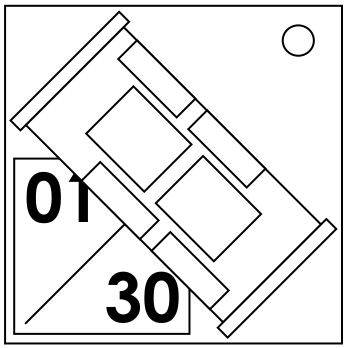
This module contains a large wooden cylinder with 6 flashing colors wrapping around it. To assist the defuser in reading and inputting colors, there are 2 numbers in the bottom-left corner of the module. The top-left number represents the position of the current flash or press, and the bottom-right represents the total number of flashes, which can be anywhere from 20 to 30. Hovering over a color will always reveal its first two letters on the bottom-right number.

To solve the module, scramble the sequence of flashing colors using 3 Scytale Transpositions, and input the new sequence.

Step 1/5: The Binary Sequence

The module requests a binary sequence containing 6 bits, which is obtained in two parts.

The first part is to take the serial number and convert them to their base-36 equivalents. If their value is in the range 5-21 (inclusive), that bit is a 1. Otherwise, it’s a 0.

The second part is to invert the bits based on the presence of certain modules, finalizing the sequence:

Invert the...
1st2nd3rd4th5th6th
...bit if the bomb contains the module...
DSimon’s SumsCruel Boolean WiresModulo MazeSTerminology

Step 2/5: Valid Colors

The module’s answer requires the use of 3 Scytale Transpositions, which depend on colors on the module and the binary sequence. Using the binary sequence, find the only rule that is true in the table below, and then follow the action to determine the positions of the colors. These positions are read top-left to bottom-right on the module.

Condition Action
The binary sequence is 111111. If the number of batteries is odd, use the first 3 colors. Otherwise, use the last 3 colors.
The binary sequence is 000000. Use the colors in positions with the same parity as the number of ports.
There are exactly 3 1s and 3 0s in the binary sequence, and the number of unlit indicators and lit indicators are not equal. If there are more lit indicators, use the colors in the positions with 1s. Otherwise, use the colors in the positions with 0s.
There are exactly 3 1s and 3 0s in the binary sequence, and the number of unlit indicators and lit indicators are equal. The first and sixth colors are valid. Add the color in the position of the second 0 if there are no indicators, or the second 1 otherwise.
There is a single 1 or a single 0 in the binary sequence. If the lone bit is a 1, use the colors immediately before the 1. Otherwise, use the colors immediately after the 0. Consider the binary sequence cyclic in this rule.
There are exactly 2 1s or 2 0s in the binary sequence, and the first bit is a 1. Treat the binary sequence as if it were in Gray Code. Convert it to binary (do nothing with the first bit, but each subsequent bit must be XORed with the previous obtained bit; for example, 111010→101100). Repeat this process until there are exactly 3 1s. The valid colors are in the same positions as the 1s.
There are exactly 2 1s or 2 0s in the binary sequence, and the first bit is a 0. Whichever value appears less often has the colors in its positions invalid. Define N as the number of port plates modulo 4, then add 1 to N. Take the Nth bit in order with the value that appears the most often (i.e. 4 times), and consider it invalid. The other 3 positions are valid.

Step 3/5: Conversion To Transpositions

Now that you have your valid colors, the module will take the colors, turn them into keys used for Scytale Transpositions, and scramble the flashing sequence accordingly to retrieve the answer.

Take the valid colors received from the previous step, as well as their positions. Look them up in the table below based on their position to obtain the keys used in Scytale Transpositions. A positive number denotes an encryption, while a negative number denotes a decryption.

Red Green Blue Cyan Magenta Yellow
1st-6-4+3+2-7+5
2nd+2-3-7+5-6+4
3rd+5+7-4-6+2-3
4th-7+6+5-4-3+2
5th+3-5-2+7+4-6
6th-4+2+6-3+5-7

Step 4/5: Executing The Transpositions

Take the colors that flash on the module, and execute the transpositions in the table. If, when viewing the module from the front, the cylinder rotates upwards, apply the transpositions from bottom to top. If it rotates downwards, apply the transpositions from top to bottom.

What Is A Scytale Transposition?

A “scytale” (in general) is a piece of wood (basically a stick) where a leather ribbon is wrapped around. In a Scytale Transposition (also known as a Scytale Cipher), the plaintext (unencrypted message) is written on the ribbon, and when the ribbon is unrolled, the order of the letters is scrambled (the ciphertext, the encrypted message).[1]

How Do I Encrypt With A Scytale Transposition?

There are two notable methods: the one in Unfair’s Cruel Revenge, and the one in Black Cipher. Due to the latter’s method being more efficient than the former, this manual will cover that method.

To start, take the key, and make a grid with a number of rows equal to the key. Let’s say that our key is 5:

From there, fill in all of the cells with some placeholder character (this manual will use dashes), from top to bottom and left to right (i.e. column-by-column) until there are as many placeholders as there are characters in the plaintext. For example, let’s say the plaintext is “THERATSITUATIONINALBERTAHASWORSENED” (35 characters). The resulting grid with placeholders would look like this:

-​-​-​-​-​-​-​
​--​-​-​-​-​-​
-​-​-​-​-​-​-​
-​-​-​-​-​-​-​
​--​-​-​-​-​-​

Next, replace your placeholder characters with the plaintext in reading order (left to right and top to bottom):

THERATS
ITUATIO
NINALBE
RTAHASW
ORSENED

Finally, read the letters in the same way you placed the placeholder characters (i.e. top to bottom and left to right) to obtain your ciphertext. In this example, “THERATSITUATIONINALBERTAHASWORSENED” is encrypted to get “TINROHTITREUNASRAAHEATLANTIBSESOEWD”.

How Do I Decrypt With A Scytale Transposition?

Even if a column goes unfinished, that should not change the method the placeholders are filled out with, nor should it change the method the letters are placed in or read.

You are still going to make a grid with a number of rows equal to the key. While you can make placeholders in this step, the letters are going to be filled out immediately after in the same method as that of the placeholders. The method remains the same as in the encryption process: top to bottom and left to right. The following example decrypts “TNGEHOTHETOERHSREIEESN” with 4 rows:

THERES
NOTHIN
GTOSE
EHERE

When the letters are placed, the plaintext needs to be read in reading order (left to right and top to bottom). The resulting message is “THERESNOTHINGTOSEEHERE”.

Step 5/5: Submission and Extra Information

After executing the necessary Scytale Transpositions, press the colors in the final order.* You must wait until the pressed color is no longer lit to press another color. The number in the bottom-left corner will show the number of correctly pressed colors. The module will solve when the sequence has been fully pressed.

If an incorrect color is pressed, the module will strike immediately. The module will then flash the answer, which becomes your new unencrypted sequence. However, the colors on the module, as well as the rotation of the cylinder, do not change.

*Due to issues with selecting the buttons, the module will allow for keyboard input. You can press a letter RGBCMY to press that color on the module.